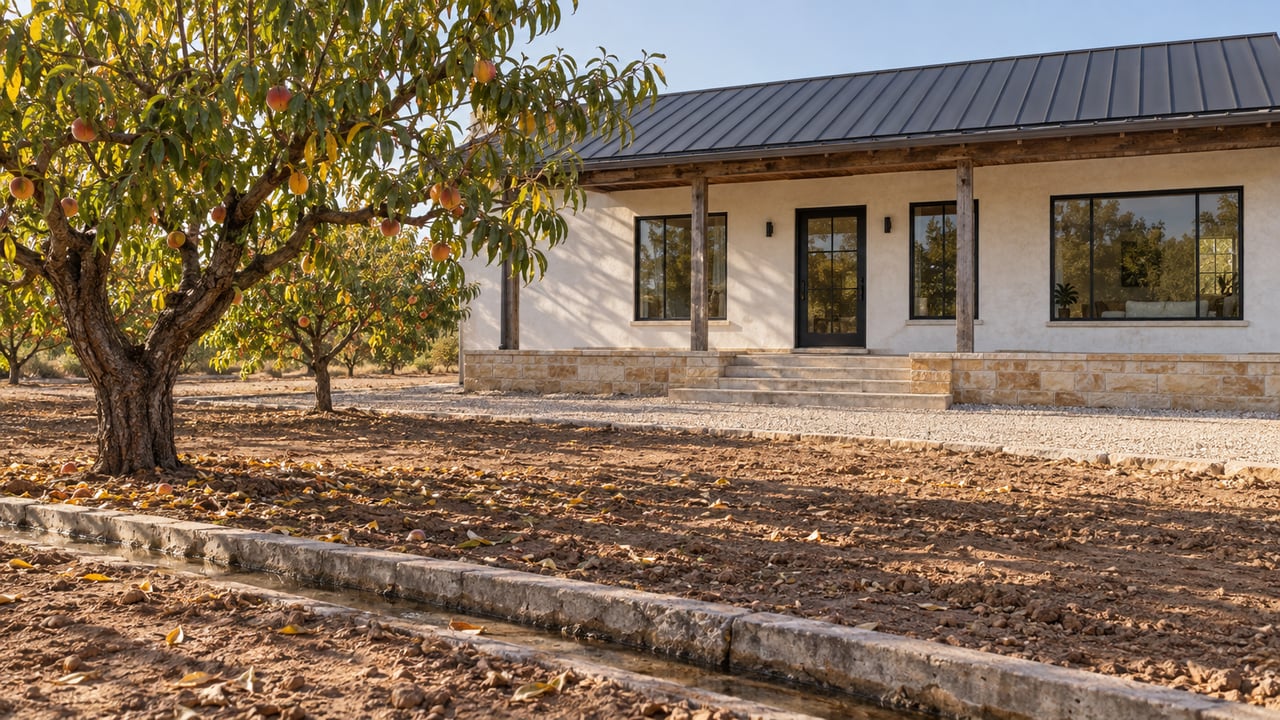
Palisade Orchard & Vineyard Water Rights: Lessons for Buyers
October 1, 2026
October 1, 2026
As WaterDesk reported, Bruce Talbott has been walking his family's peach orchards in Palisade since before most of the wine country tasting rooms across town existed. Talbott Farms plants roughly 5,000 new trees a year to replace older ones, and this year Bruce found himself worried about something he had never had to worry about before: whether the water would hold out long enough to finish picking. "We have never had the canal shut off," Talbott told WaterDesk this summer, describing 2026 as worse than the tight years of 1977 and 2002 combined.
That sentence is the whole reason to write this post. Listings across Palisade describe orchard and vineyard parcels as having "excellent water rights," and buyers tend to read that phrase the way they'd read "granite countertops." A feature. Present or absent. What 2026 exposed is that water rights in Palisade aren't a single fact you check off. This is the year that water rights stopped being theoretical and started determining which orchards kept water and which didn't.
The first thing a buyer needs to understand is that "Palisade has water rights" isn't one system. It's three, and they don't overlap the way you'd expect.
| District | What it serves | Origin |
|---|---|---|
| Palisade Irrigation District | Eastern Grand Valley, from residential subdivisions to orchards and vineyards | Delivers raw Colorado River water throughout the district; Palisade Irrigation District assesses every parcel, not just farms |
| Grand Valley Irrigation Company | About 40,000 acres from Palisade to Mack | Privately owned canal system running since 1882, nearly 100 miles of canal, 48,000 shares held by roughly 3,000 shareholders |
| Orchard Mesa Irrigation District | 9,219 acres including the Vinelands area | An irrigation district lifting Colorado River water through four hydraulic pumps, with canals dating back roughly 120 years |
A parcel's water rights are tied to its water system. Buying a house on one side of a lateral and a house on the other side can mean two entirely different water providers, different assessment schedules, and different exposure to a dry year. None of this shows up on a listing photo.
Even inside a single system, the rules aren't uniform. Palisade Irrigation District's assessment structure charges $105 a year for the first acre or less and $20 per acre for everything above that, and it applies to every parcel in the district, whether it's 30 acres of peach trees or a third-acre residential lot. You don't have to be farming to owe into the system.
As The Colorado Sun reported, what's harder to grasp until you've lived through a year like this one is how thin the margin gets even for the oldest rights. Mesa County holds some of the most senior water rights in the state, including the decree known locally as the Cameo call, which diverts Colorado River water at a roller dam just upstream of Palisade. Even with that seniority, farmers under the Grand Valley Water Users Association spent this season working with roughly 1 cubic foot per second of water per 40 acres, a fraction of a normal allocation, and the association wasn't even pulling its full legal maximum. It was targeting about 500 cfs below what its rights technically allow, because there simply wasn't more river to take.
The river itself told the story in August 2026. Flow near Palisade briefly dropped to 42.9 cubic feet per second before rebounding to about 88 cfs by afternoon, a level normally associated with a creek, not the Colorado River, which typically runs around 1,200 cfs in August. Cumulative streamflow at Cameo, just upstream of Palisade, was the lowest recorded in nearly a century of record-keeping. Dan Crabtree, superintendent of the Palisade Irrigation District, told The Colorado Sun: "We've never seen anything like this."
Orchard Mesa Irrigation District's Vinelands Power Plant was shut down in April because there wasn't enough river flow to spare for hydropower generation.
Here's the part that catches buyers off guard at the transaction table, not the county records office.
Grand Valley Irrigation Company requires the physical stock certificate to be present in its office before a transfer can complete. Every named seller on that certificate has to sign. The annual assessment for the current year has to be paid in full, even if the seller is only transferring part of their shares. A $30 transfer fee applies per new certificate issued.
A GVIC share is a direct flow right, about 4.6 gallons per minute per share. For the 2026 season, an A share carried an assessment of $376.90 and each additional B share cost $18.03.
For a buyer looking seriously at orchard, vineyard, or acreage property in Palisade, the standard "does it have water rights" question isn't specific enough. Better questions look like this:
These aren't questions a standard home inspection answers. They're questions for the water provider's office directly, and in a year when three different districts spent months in genuine crisis mode, getting straight answers before you're under contract is worth the extra week it might take.
None of this means Palisade's water system is failing. It means it's old and it's being rebuilt in real time. Orchard Mesa Irrigation District's Canals 1 and 2, roughly 120 years old, are the subject of an active federal project to convert 8.4 miles of open, earthen canal into pressurized pipeline. The work is funded by close to $10.5 million from the U.S. Bureau of Reclamation, expected to cut diversion losses by up to 6,900 acre-feet a year and eliminate another 2,560 acre-feet lost to seepage annually, along with $1.4 million for new flow meters that will let the district measure deliveries in real time instead of estimating them. That project was still in the engineering and permitting phase as of the district's most recent bid solicitation, which means the benefits are years away, not this season.
For a buyer today, the honest way to think about a Palisade water right is less like a fixed asset and more like a position in a line that's gotten a lot more crowded this year. The house is stable. The orchard behind it is stable. The water that keeps both alive runs through a system built in stages over more than a century, and 2026 is the year that showed exactly where each parcel stands in that line when the river runs thin.
If you're looking seriously at acreage, an orchard, or a vineyard parcel in Palisade, it's worth walking through the water picture on a specific property before you write an offer, not after. Michelle Ritter has spent her career working Grand Valley transactions where the water is as much a part of the deal as the square footage, and she can help you ask the district the right questions before you're locked into a contract.
This article is general information, not legal, tax or financial advice. Consult a qualified professional about your situation.
Stay up to date on the latest real estate trends.
A thoughtful, results-focused approach designed around each client’s unique goals. Every project is handled with clarity, attention to detail, and a collaborative process that ensures effective, well-aligned outcomes from start to finish.